Nail holes and the whole deposit is gone? Normal wear vs damage: which deductions are illegal
Civil Code 432 and 433: ordinary wear is not yours to pay. How to tell wear from damage, what evidence to keep, and what to do when you disagree.
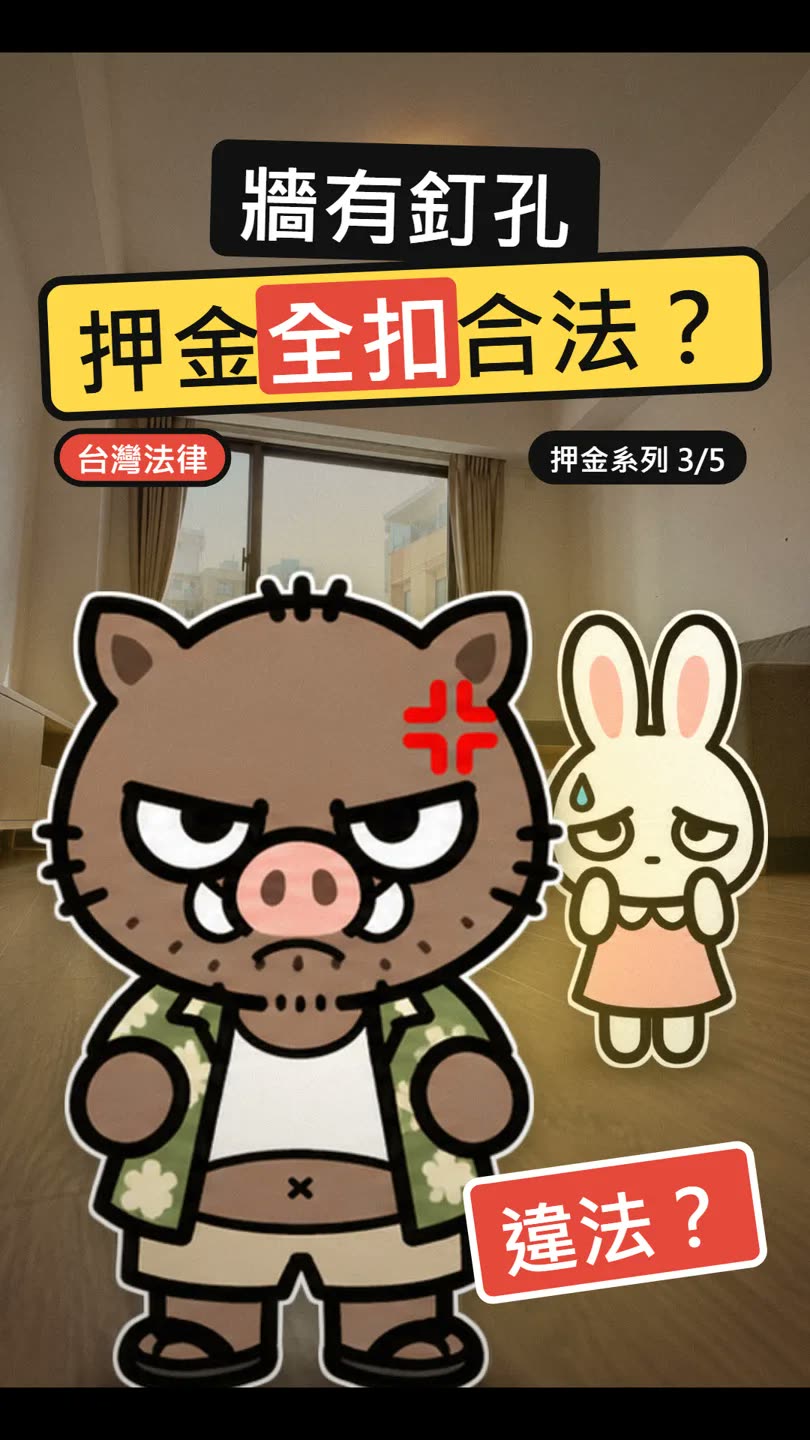
On move-out day the landlord hands you a list: three nail holes NT$3,000, repainting yellowed walls NT$8,000, scratched floor NT$5,000, and the deposit is exactly used up. It happens all the time, and most of it is not legal. Taiwanese law draws a clear line between "this happens with normal use" and "you broke it". The first cannot be deducted. This is Part 3 of the deposit series: where the line is, and what to do when you disagree.
01Where the law draws the line: wear and tear is not yours to pay
Article 432 of the Civil Code asks the tenant to look after the unit with reasonable care; Article 433 says wear caused by normal use in the agreed way is not the tenant's responsibility. The Ministry of the Interior's model residential lease says the same: the tenant pays for damage, but natural wear and tear is excluded.
- Normal wear (cannot be deducted): small nail holes from pictures or a clock; walls yellowed by sunlight, small marks in corners; everyday scuffs and light scratches on floors; aged window screens, worn tap washers, light tubes that reached end of life.
- Damage (can be deducted, but the landlord must prove it): broken glass, a scorched kitchen counter, large holes or graffiti on walls, a door clawed by a pet, a toilet blocked so badly it needs replacing, a leak you never reported that turned into mould.
- The amount is limited too: only the reasonable cost of restoring the original state, with depreciation. After 5 years, old paint does not entitle the landlord to a full fresh repaint at your cost.
02If the landlord wants to deduct, the proof is on them
Whoever claims "you broke it" has to prove it. At minimum the landlord should show a photo of the damage, proof it was not there on move-in (usually the handover record) and a repair quote or invoice. "The wall is dirty, I need to repaint" with no paperwork is something you can refuse.
- Ask the landlord to list each item: where, what damage, what repair, how much, with a quote attached.
- Reply item by item, agree or disagree, and give a reason for each disagreement (normal wear / already there on move-in / unreasonable amount). Do it in writing; LINE messages count.
- You can compromise on items you are willing to cover, but never sign a blanket "I agree to all deductions" just to get the rest back faster.
03The most useful evidence: one set of photos on move-in, one on move-out
- Move-in day: photograph and film every room, wall, floor, door, window and appliance with timestamps on. Take close-ups of nail holes and stains that are already there.
- Handover checklist: sign a condition checklist with the landlord that records existing defects. The Ministry of the Interior's model lease includes one as an appendix.
- Move-out day: shoot the same angles again. Side by side, normal wear and real damage are obvious. Photograph the emptied unit and the key handover too.
- Keep together: the lease, the deposit receipt or transfer record, and every chat record. All of it is used at mediation and in court.
- Ministry of the Interior real-estate information platform: model lease and condition checklist — The model lease contains the wear-and-tear clause and the condition form
04You disagree with the deduction: the path
- State in writing that you disagree, and ask for the undisputed part of the deposit back within 7 days.
- Send a registered demand letter (how to write it is Part 2), stating clearly what you accept and what you refuse.
- Apply for mediation at the district office where the property is. It is free and needs no lawyer (Part 4).
- If the landlord does not show or no agreement is reached, apply to the court for a payment order (NT$500) or file a small claim (Part 5).
- You can also ask your city's rental dispute service, the 1950 consumer hotline, or the Legal Aid Foundation at 412-8518.
- Legal Aid Foundation (national line 412-8518) — Free legal consultation
- Judicial Yuan (small claims, sample pleadings)
05The rest of the deposit series
This guide is one of five in the deposit series. Every part has a reel on Instagram @lawbao.tw; comment the keyword under a reel and the full guide for that part lands in your DMs.
- Part 1 | Landlord keeping your deposit? One legal move gets it back — Instagram reel
- Part 2 | How to write a demand letter that works — Comment "信函" on the reel to get this link
- Part 3 | Which deposit deductions are legal (this one) — Comment "耗損" on the reel to get this link
- Part 4 | What happens on mediation day — Comment "調解" on the reel to get this link
- Part 5 | A NT$500 payment order makes them pay — Comment "命令" on the reel to get this link
06Things to watch
- A lease clause saying "the tenant pays for a full repaint on move-out" may be void as unfair, but do not decide that alone; raise it at mediation.
- Damage caused by pets usually counts as damage, not wear; pet owners should document the unit extra carefully on move-in.
- A landlord's own upgrades or new furniture are never your cost.
- A cleaning fee is only reasonable when the lease provides for it or you really left a lot of rubbish behind.
Sources
What should we explain next?
Every reel has a full guide. Follow @lawbao.tw and check here first before you decide whether you need a lawyer.

TrialAI
Want to know how your case would go?
TrialAI runs an AI mock trial and predicts the outcome. Describe your situation and see your odds before you decide what to do next.