Unmarried couple paid the deposit, home in his name: who keeps it after a break-up? Co-own, sign, keep records
Property follows registration (Civil Code 758, 759-1). Register shares, or sign an agreement and keep transfer records; how to claim money back.
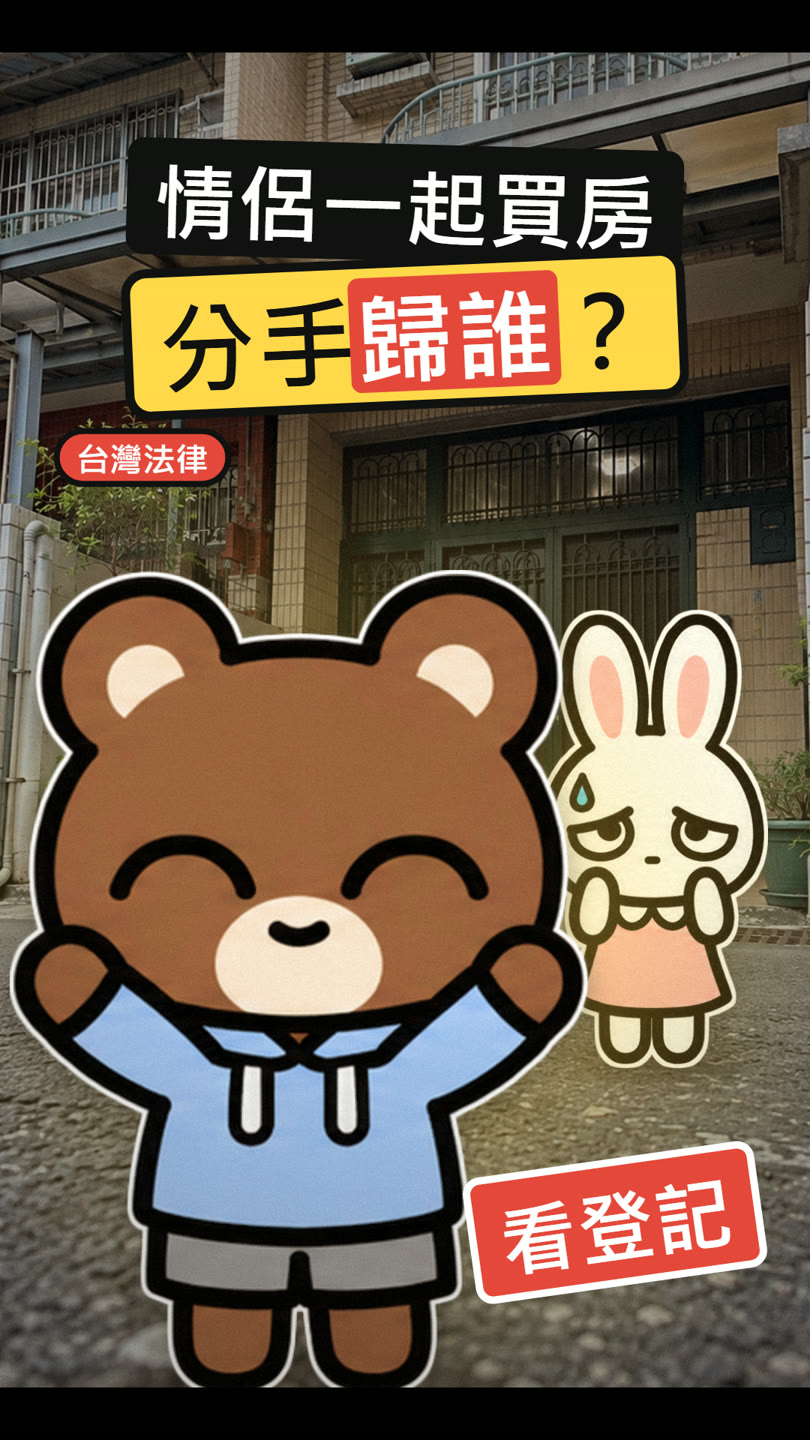
You and your boyfriend put down the deposit together, but for convenience the home is registered only in his name. After the break-up he says the home is his and your money is gone. In Taiwan, property in principle belongs to whoever is registered, and an unmarried couple has no marital property to divide. To protect yourself, register co-ownership by contribution before buying, or at least sign a written agreement and make every payment by bank transfer.
01Step 1: know the rule: property follows registration
Civil Code Article 758: rights in real property take effect only on registration. Article 759-1: the registered holder is presumed to hold the right lawfully. If only one of you is registered, the home is in principle theirs.
- An unmarried couple cannot claim a division of marital property.
- To get your money back you must prove it was a contribution to the purchase, not a gift.
02Step 2: safest: register co-ownership by contribution
Civil Code Article 817: people who own one thing in shares are co-owners. Before buying, register co-ownership (分別共有) by contribution: put in 1/3, register a 1/3 share. Each co-owner uses and benefits in proportion to their share (Article 818).
- Agree your contribution shares before signing the purchase contract.
- Register the transfer as co-ownership with each share stated.
- On a break-up you can agree to sell and split the money, or ask the court to divide it (Civil Code Articles 823 and 824).
- Department of Land Administration, Ministry of the Interior — Property registration information; registration is done at the local land office
03Step 3: only one name on the deed? Sign a written agreement
Sometimes only one of you can be registered, for example to use a first-home loan. Then you must have a written agreement.
- How much each of you contributed.
- Who pays the mortgage.
- How you settle up if the home is sold or you break up.
- Consider having it notarised.
- Or file a caution registration (預告登記) that stops the other person freely disposing of the home (Land Act Article 79-1).
- Judicial Yuan — Court notary offices and private notaries
04Step 4: keep a money trail; pay everything by transfer
- Pay the deposit, mortgage and renovation by bank transfer.
- Add the note "購屋款" (home purchase) to each transfer.
- Keep passbooks, transfer screenshots and your messages with each other.
05Step 5: already broken up with no agreement
You can argue a nominee registration arrangement (借名登記), or claim the money back as unjust enrichment under Civil Code Article 179. The key is proving the money was a contribution to the purchase, not a gift.
- Gather the payment records and messages.
- Send a certified letter (存證信函) first.
- Then apply for mediation or sue.
- Chunghwa Post — Certified letters are sent at the post office
06Step 6: where to ask
- Your local land office (registration questions).
- Legal Aid Foundation, 412-8518.
07Things to watch
- While the home is in his name, if he sells or mortgages it, a buyer or bank relying on the register is usually protected (Civil Code Article 759-1(2)); you can only pursue him for the money.
- For a nominee registration or unjust enrichment claim, the burden of proof is on you; a verbal promise and cash payments are hard to rely on.
- The agreement should also cover what happens if someone stops paying the mortgage or one of you wants out early.
- This guide is about unmarried couples; once married, the marital property rules apply instead.
Sources
What should we explain next?
Every reel has a full guide. Follow @lawbao.tw and check here first before you decide whether you need a lawyer.

TrialAI
Want to know how your case would go?
TrialAI runs an AI mock trial and predicts the outcome. Describe your situation and see your odds before you decide what to do next.